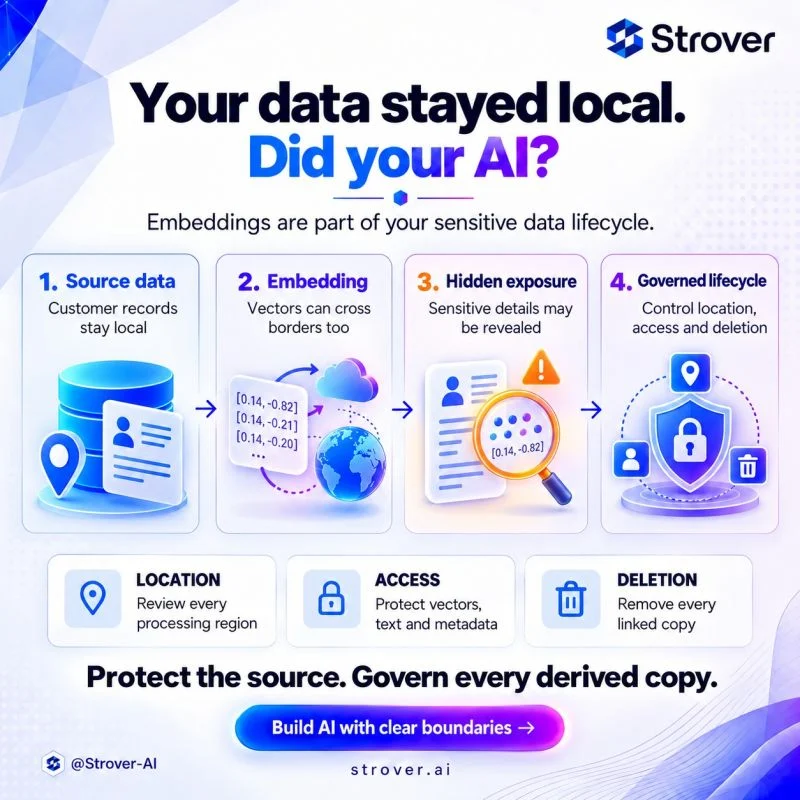
Turning sensitive text into numbers doesn’t automatically make it anonymous. Research on embedding-inversion attacks shows that source text can be reconstructed from vectors under certain conditions.
At Strover, that means we treat vector embeddings as part of the sensitive data lifecycle, not as a harmless cache.
Our RAG architecture runs on PostgreSQL with pgvector. But the database choice alone doesn’t establish privacy or data residency. The whole path matters:
Source dataEmbedding modelVector storageRetrievalModel response
These requirements guide that architecture:
- Review every processing locationEmbedding APIs, vector indexes, model endpoints, logs, replicas and backups all count when checking customer-approved data boundaries.
- Minimise data before embeddingLeave out unnecessary personal information and secrets. Where an identifier is needed, tokenize it before it reaches the embedding model.
- Look beyond the vectorsRaw text chunks and metadata are often stored next to each embedding for faster retrieval. Moving the index can mean moving the original text too.
- Protect storage and retrievalApply encryption, tenant isolation and access controls. Encryption at rest alone won’t stop inversion by someone who can read the vectors.
- Connect deletion to the AI lifecycleDeleting a source record should also remove its chunks, embeddings and cached copies, with backup retention handled explicitly.
- Keep decisions reviewableDocument where data is processed, who can retrieve it, and how retention and deletion work.
The question for enterprise AI teams is simple:
Can you account for every derived copy of your customer’s data, including the vectors?
#StroverAI#AISecurity#DataPrivacy#RAG#AIGovernance#pgvector#DataResidency